Tether Autonomous Functional Play with Correspondence-Driven Trajectory Warping


†Equal advising
†Equal advising
TLDR. Tether performs autonomous real-world functional play involving structured, task-directed interactions. We introduce a policy that performs trajectory warping anchored by keypoint correspondences, which is extremely data efficient and robust to significant spatial and semantic environment variation. Running the policy within a VLM-guided multi-task loop, we generate a stream of play data that consistently improves downstream policy learning over time.
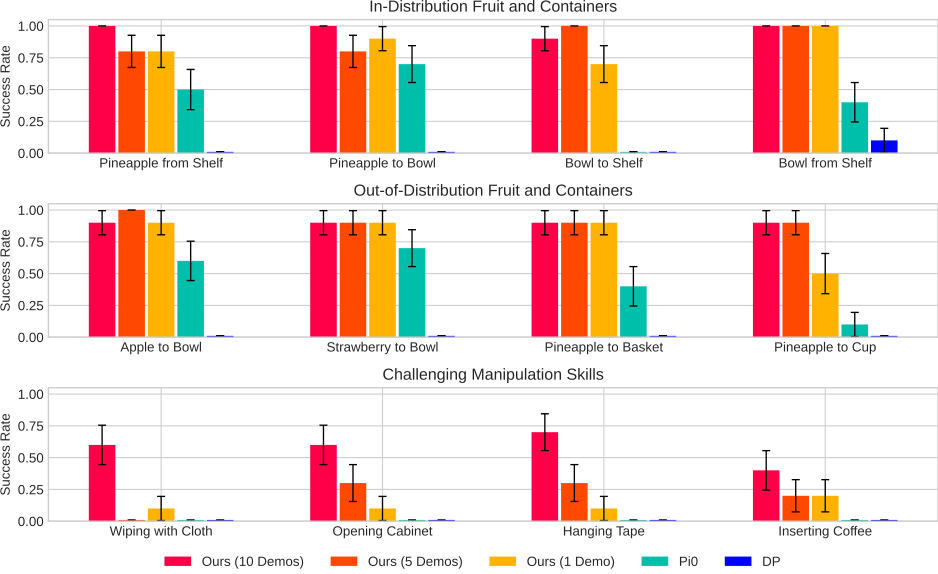
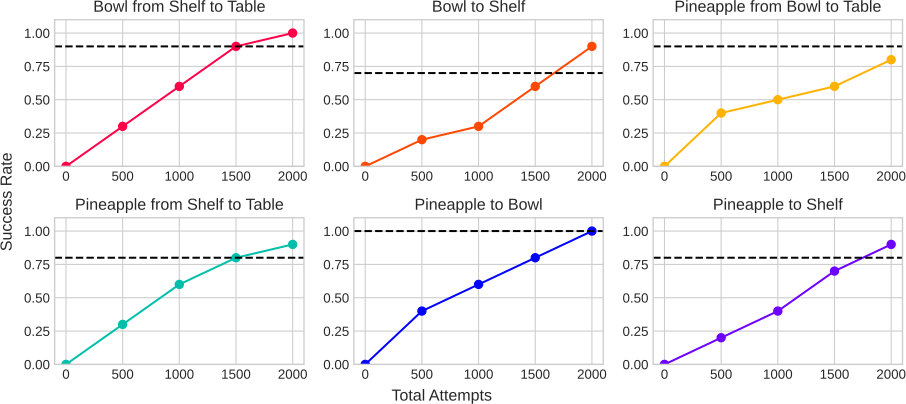
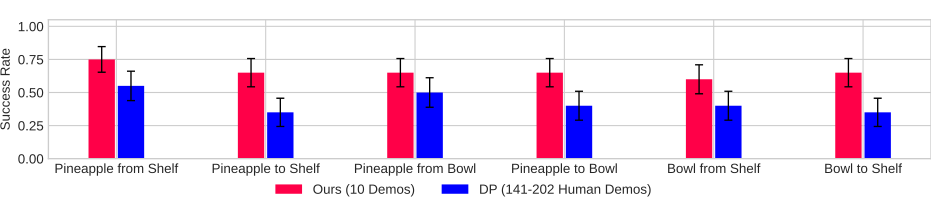
The ability to conduct and learn from interaction and experience is a central challenge in robotics, offering a scalable alternative to labor-intensive human demonstrations. However, realizing such "play" requires (1) a policy robust to diverse, potentially out-of-distribution environment states, and (2) a procedure that continuously produces useful robot experience. To address these challenges, we introduce Tether, a method for autonomous functional play involving structured, task-directed interactions. First, we design a novel open-loop policy that warps actions from a small set of source demonstrations (≤10) by anchoring them to semantic keypoint correspondences in the target scene. We show that this design is extremely data-efficient and robust even under significant spatial and semantic variations. Second, we deploy this policy for autonomous functional play in the real world via a continuous cycle of task selection, execution, evaluation, and improvement, guided by the visual understanding capabilities of vision-language models. This procedure generates diverse, high-quality datasets with minimal human intervention. In a household-like multi-object setup, our method is the first to perform many hours of autonomous multi-task play in the real world starting from only a handful of demonstrations. This produces a stream of data that consistently improves the performance of closed-loop imitation policies over time, ultimately yielding over 1000 expert-level trajectories and training policies competitive with those learned from human-collected demonstrations.

@misc{liang2026tether,
      title={Tether: Autonomous Functional Play with Correspondence-Driven Trajectory Warping},
      author={William Liang and Sam Wang and Hung-Ju Wang and Osbert Bastani and Yecheng Jason Ma and Dinesh Jayaraman},
      year={2026},
      eprint={2603.03278},
      archivePrefix={arXiv},
      primaryClass={cs.RO},
      url={https://arxiv.org/abs/2603.03278},
}